Chiaying:
Your work in this exhibition—The Ruling ( The Banque de l'Indochine's Profits, 1875–1939), Anti-Trauma Walk, and Quôc Monopolô—is incredibly powerful. You've managed to translate the abstract violence of colonial history into an undeniable, physical reality that we must experience with our bodies.
Knowing your personal history—moving from Vietnam to Germany as a child and growing up amidst its reunification—your focus on bureaucracy, displacement, and state power feels so deeply personal.
Here in Taiwan, we also live with the complex layers of our own colonial and authoritarian pasts (from Japanese rule to the KMT). This makes your investigation of French Indochina feel particularly resonant.
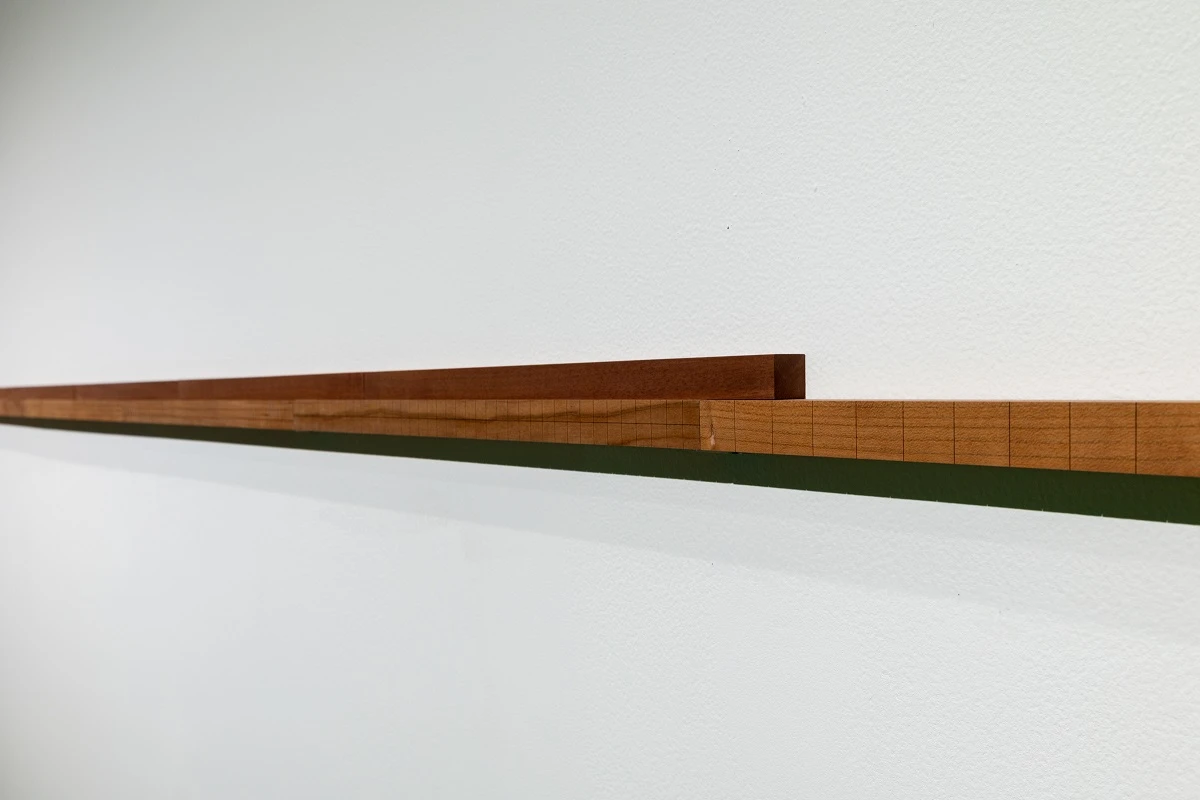
The Ruling ( The Banque de l'Indochine's Profits, 1875–1939 ), 2025, 47 cm and 40 cm rulers, two different woods, engraved, varnished, brackets, 4.35 x 1504 x 2.35 cm, Courtesy of the artist. Installation View, Taipei Biennial 2025. Photo: Guo-way Lu
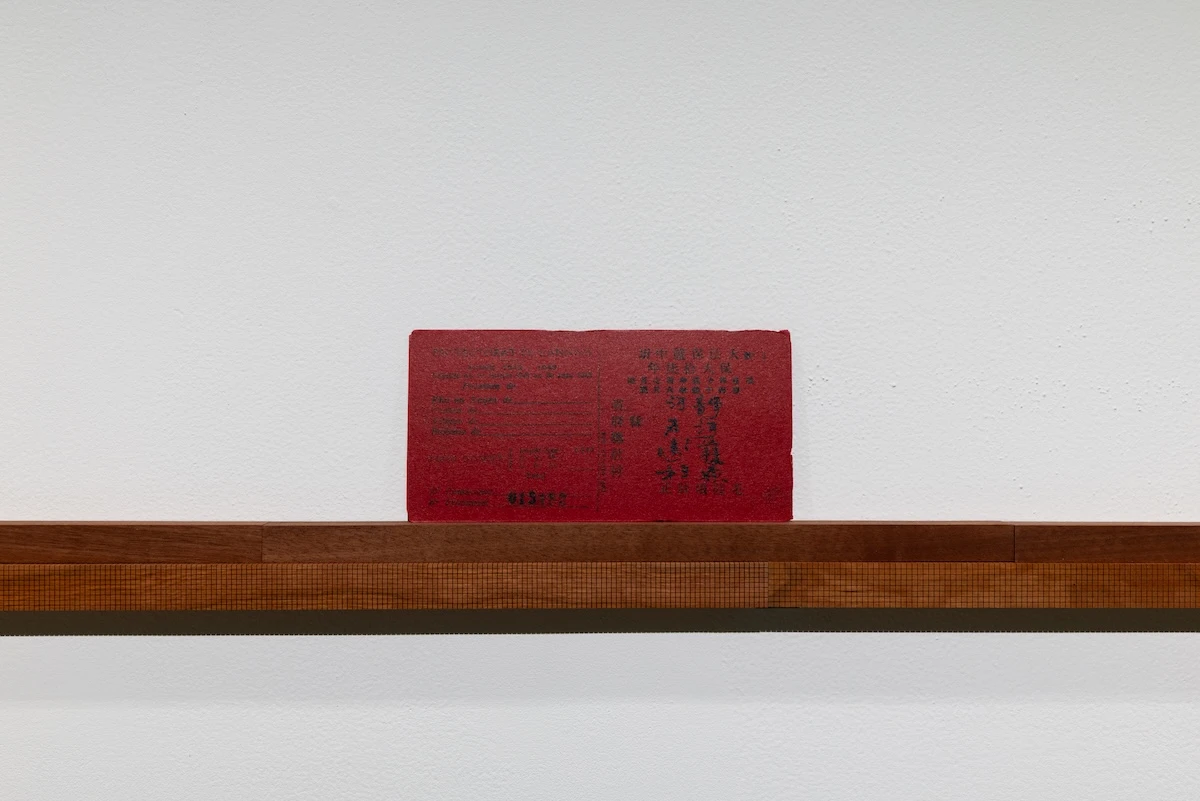
The Ruling ( The Banque de l'Indochine's Profits, 1875–1939 ), 2025, 47 cm and 40 cm rulers, two different woods, engraved, varnished, brackets, 4.35 x 1504 x 2.35 cm, Courtesy of the artist. Installation View, Taipei Biennial 2025. Photo: Guo-way Lu
Chiaying:
I was immediately struck by The Ruling ( The Banque de l'Indochine's Profits, 1875–1939). You took something as abstract as colonial bank profits and turned it into a 15-meter-long physical ruler—a tool that itself represents rationality and control. It's such a powerful gesture. I'd love to hear you talk about this process of "translating" abstract numbers (profits) into physical distance (15 meters). And by forcing the viewer to walk to read it, is this "walking" your way of responding to the cold, seemingly neutral language of those colonial archives? Also, what is the specific significance of the 40-centimeter base unit?
Sung:
The Ruling ( The Banque de l'Indochine's Profits, 1875–1939) began from my interest in how systems of measurement translate power into something that appears abstract, objective, or neutral. Colonial archives are full of numerical records and tables, yet these tableaux conceal the violence and human exploitation that produced them. By turning those records into a 15-meter-long ruler, I wanted to give material weight and spatial presence to something that usually exists only on the page.
The act of walking alongside the ruler is essential—it turns the viewer's body into a unit of measurement itself. You have to move in order to read it, to trace the data physically. This reintroduces embodiment to information that has been stripped of it by bureaucratic language.
The 40-centimeter base unit refers to a historical standard introduced in French Indochina, when the colonial administration replaced the local measuring stick—the thước đo đất (used to measure land), which measured approximately 47 centimeters—with a shorter 40-centimeter version. This seemingly minor adjustment made land easier to survey, divide, and tax. Measurement itself thus became a form of domination—an administrative violence hidden in plain sight.
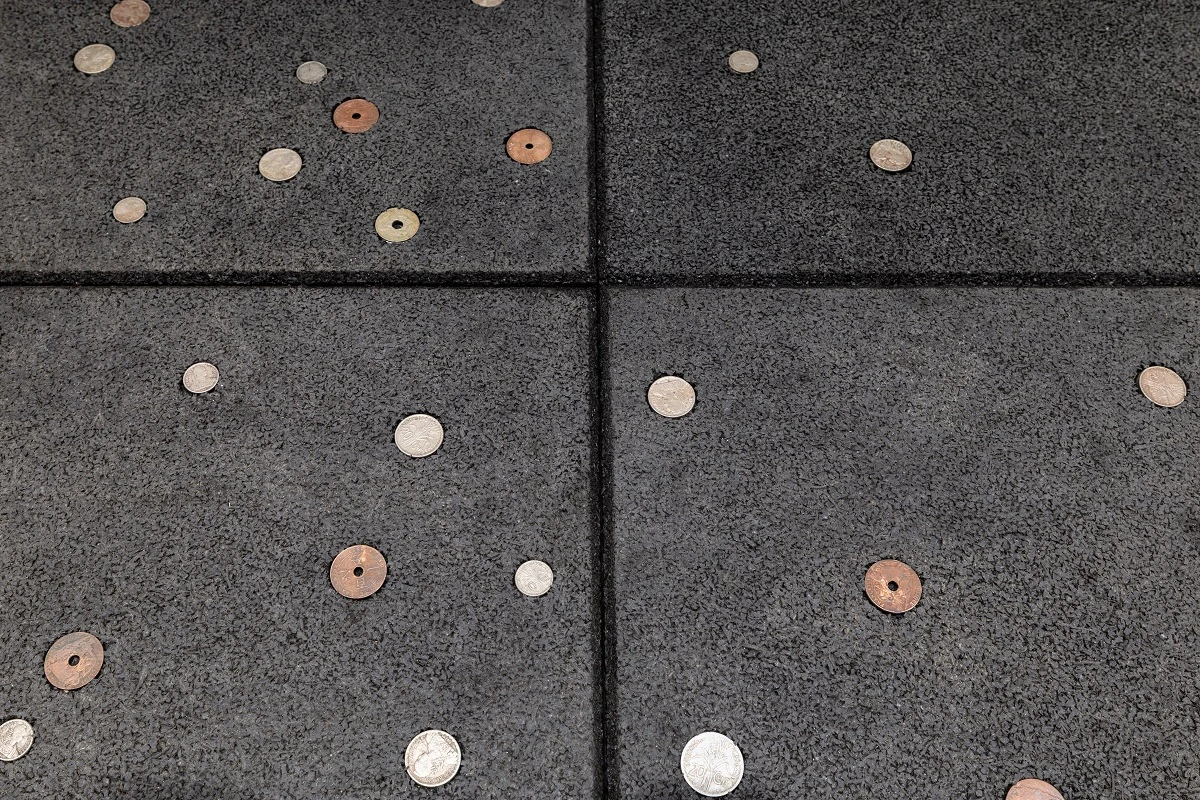
Anti-Trauma Walk, 2025, 40 x 40 cm, anti-trauma rubber mats, French Indochinese coins, in 126 parts, 1680 x 120 cm, Courtesy of 69 Art Campus. Installation view, Taipei Biennial 2025. Photo: Guo-way Lu
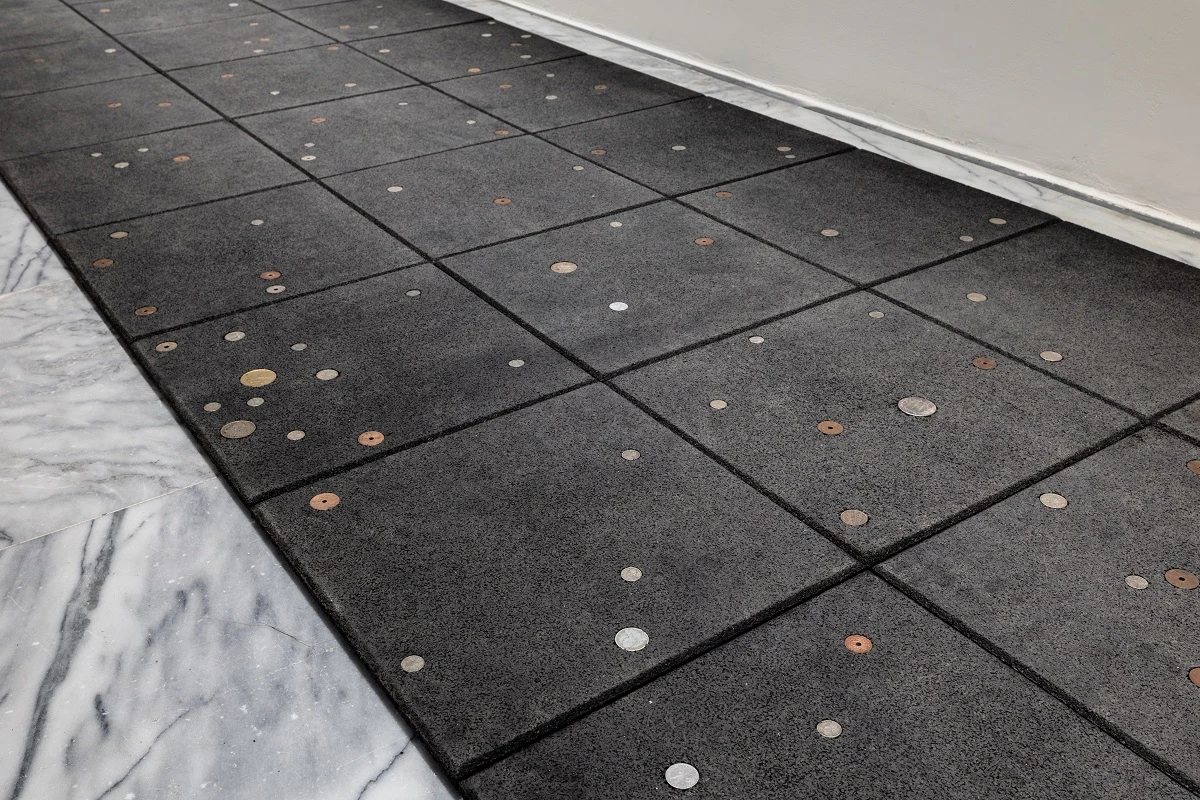
Anti-Trauma Walk, 2025, 40 x 40 cm, anti-trauma rubber mats, French Indochinese coins, in 126 parts, 1680 x 120 cm, Courtesy of 69 Art Campus. Installation view, Taipei Biennial 2025. Photo: Guo-way Lu
Chiaying:
Then, directly underneath our feet, is the Anti-Trauma Walk. The choice of rubber feels so poignant. It's this material of colonial plunder, yet its physical properties are all about cushioning. This resonates strongly here in Taiwan, as we had our own colonial commodities like camphor and sugar. Could you elaborate on your choice of this deeply contradictory material? And it makes me wonder about the title, "Anti-Trauma." How should we understand the "Anti-"? Are we re-enacting trauma, or are we being asked to "process" or "resist" it?
Sung:
Rubber is a deeply charged material. It embodies the history of colonial extraction, forced labor, land exploitation, displacement and so much more, while simultaneously carrying associations of progress, mobility, protection, and elasticity.
By embedding Indochinese coins into the rubber floor, history is recalled beneath the audience's feet. The surface may be soft, but the narrative beneath it is not. The prefix Anti- reflects this double meaning. The material both contains trauma and is designed to absorb or cushion impact. Anti-Trauma Walk does not resolve trauma, but it exposes the paradox of a material meant to protect bodies while being produced through their harm.
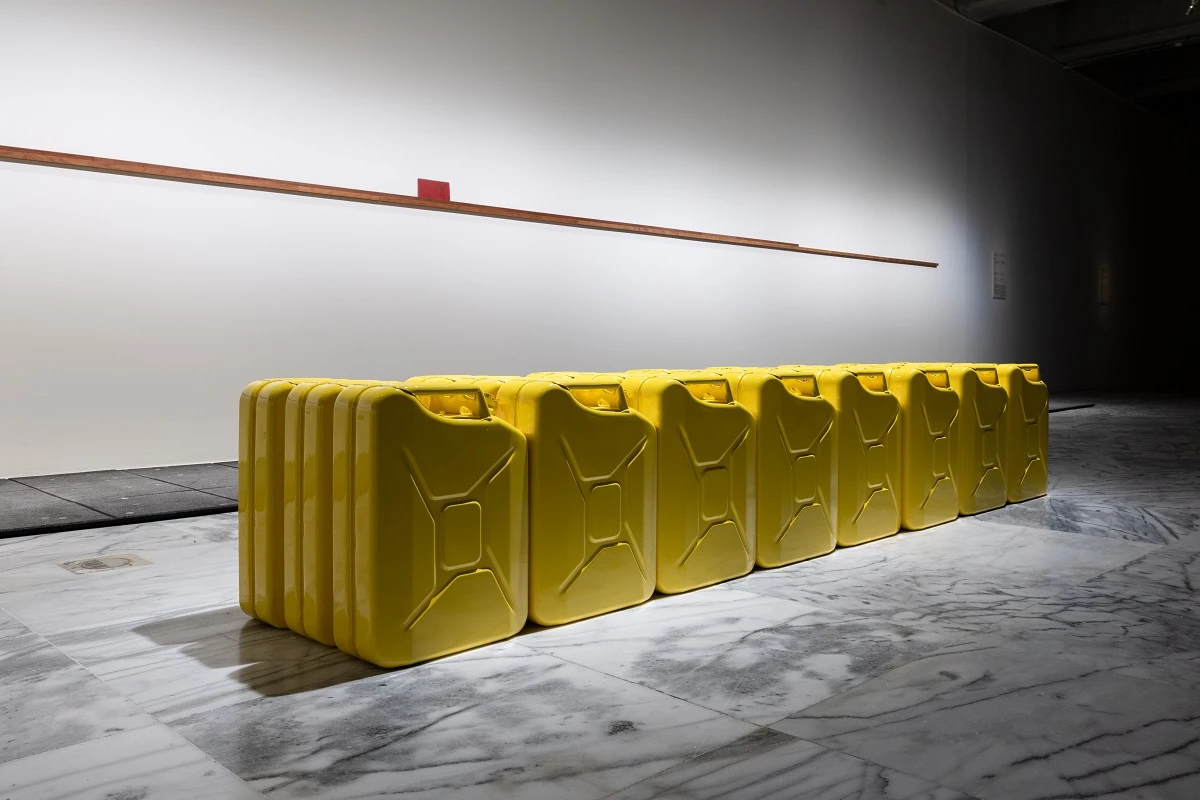
Quôc Monopolô, 2024, 23 gas canisters filled with gasoline, 1 gas canister filled with medication, printed document, framed, 47 x 278 x 50 cm, Courtesy of the artistInstallation view, Taipei Biennial 2025. Photo: Guo-way Lu
Chiaying:
The title Quôc Monopolô is brilliantly satirical—that fusion of the Vietnamese "Quốc" (State) and "Monopoly." This is also particularly intriguing in the Taiwanese context, as we also had a state monopoly on tobacco and liquor, a legacy from the Japanese colonial era. Are you using this "game" metaphor to expose the arbitrary rules, the power asymmetries, and the colonial "State" acting as the ultimate banker? In that context, does that 1904 archival document function almost like an "instruction manual" for how these systems still operate?
Sung:
Quôc Monopolô adopts the language of play to expose the rule-based asymmetries of domination. Like the game Monopoly, control is centralized: one authority sets the conditions and determines who may continue to participate. The term Quốc (nation or state) foregrounds sovereignty itself as an economic mechanism, where governance and profit converge.
The 1904 archival document introduces a different register. It is a husband's petition to the colonial authorities, pleading for the return of his wife after a misunderstanding and denying any illegal production of contraband alcohol. I find this document deeply moving because it reveals a fragile, personal attempt to negotiate with an impersonal system, filled also with cultural misunderstandings. Within Quôc Monopolô, it exposes what it means to be caught inside the rules of an arbitrary game.
Chiaying:
This, for me, is where the work hits hardest. Your description mentions "the violence of the institution is substituted by the viewer's corporeal sensation." It makes every step feel heavy. Could you talk more about how you designed this mechanism of "corporeal substitution"? In an age where we're so used to understanding history through screens, are you trying to awaken a more direct empathy, or perhaps even that uncomfortable feeling of our own complicity?
Sung:
I don't see complicity as something that belongs only to screens or mediated forms of knowledge. We are already implicated, whether we engage history digitally or physically.
In Anti-Trauma Walk, the sensation of heaviness or unease emerges from the realization that the ground you walk on was shaped by historical processes and we, the audience, continue to participate in them. The work is about recognizing that we are not positioned outside these systems, but are right in them.
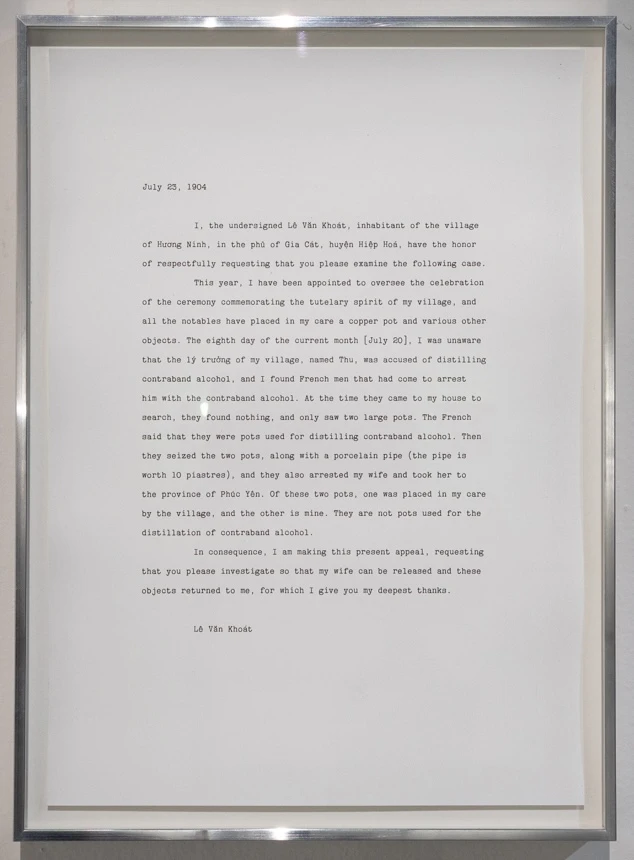
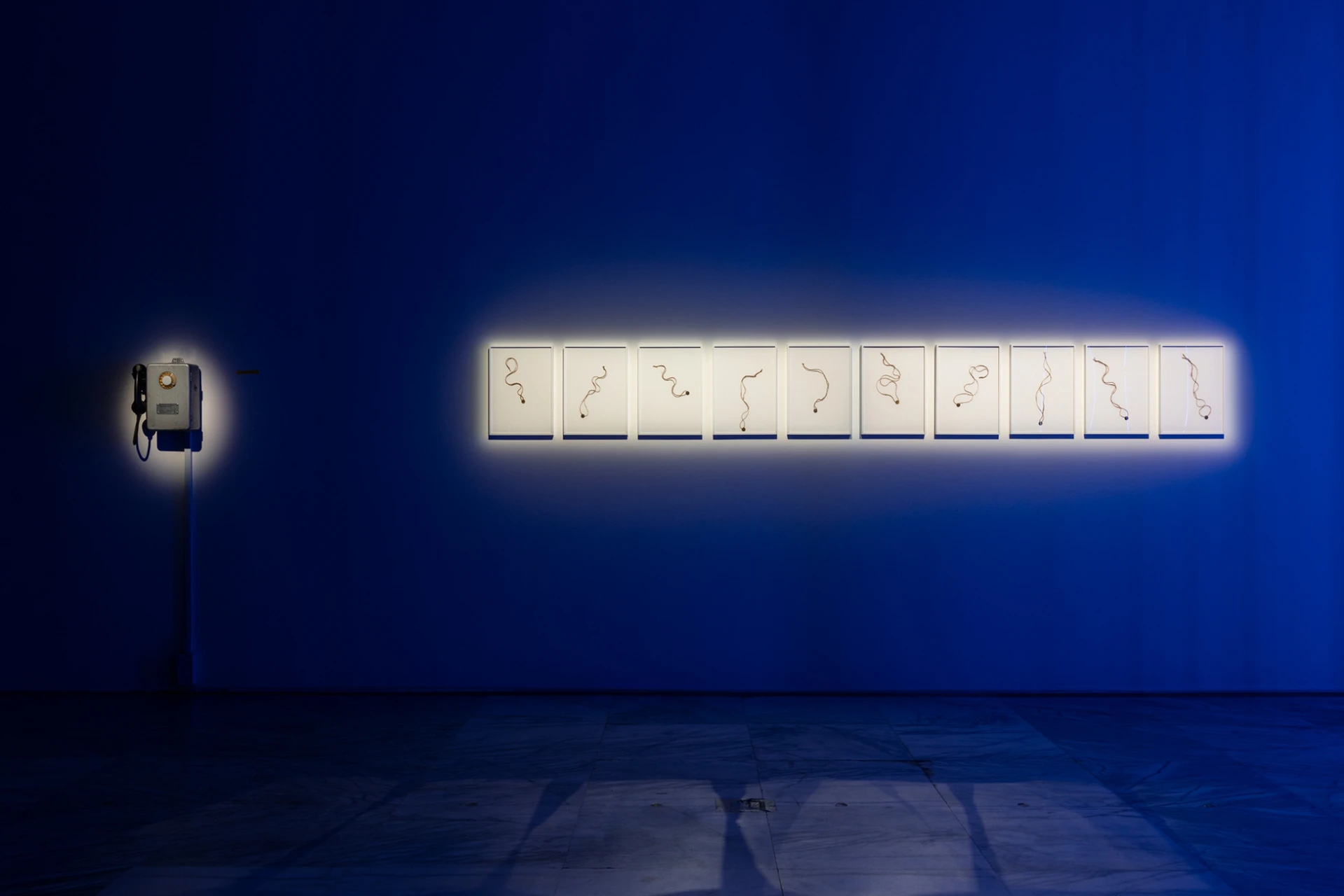
Untitiled, 2025, Print on paper, 10 x 18 cm, Courtesy of the artist. Photo: Guo-way Lu
Chiaying:
I'm also curious about how this work connects to your wider practice. You've consistently investigated the bureaucracy of the Cold War and surveillance, which I imagine is deeply connected to your own biography. This time, by tracing back to 1875–1939, it feels like you're digging for an even earlier root. Do you see this colonial financial mechanism as a "genealogical" origin point for the structural violence you explore in your other works?
Sung:
What interests me is the persistence of these techniques rather than their historical framing. Measurement, accounting, and surveillance enabled colonial extraction and governance, later, they were absorbed into Cold War infrastructures and, ultimately, into contemporary systems of global administration. In this sense, colonial financial mechanisms function as one of such operational origin points for the forms of structural violence I examine elsewhere.
The Ruling ( The Banque de l'Indochine's Profits, 1875–1939), Anti-Trauma Walk, and Quôc Monopolô each isolate a different aspect of this inheritance—measurement as authority, material extraction as infrastructure, and bureaucracy as a self-reinforcing system—revealing how mechanisms survive by refining its methods rather than abandoning them.
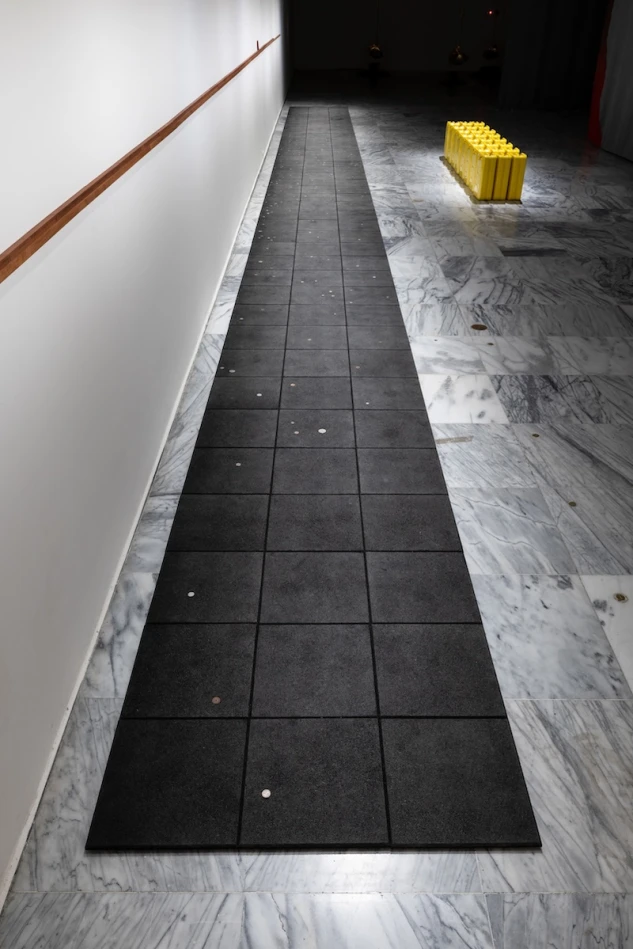
Installation view, Taipei Biennial 2025. Photo: Guo-way Lu
Chiaying:
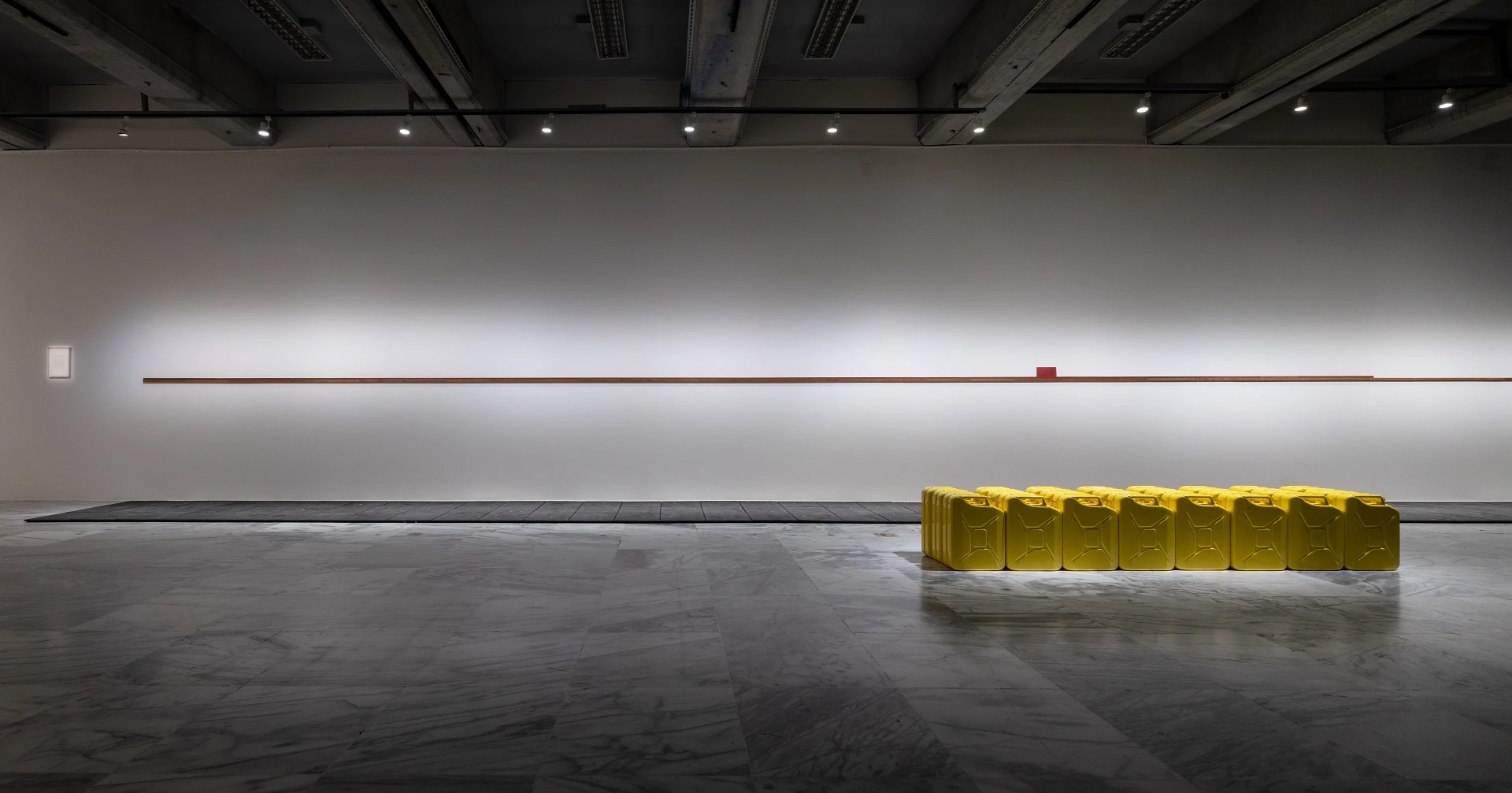
Finally, I'd love to hear how you see these three pieces breathing together as a "total installation" in the space. It feels so complete: The Ruling ( The Banque de l'Indochine's Profits, 1875–1939) as the linear, official narrative above, Anti-Trauma Walk as the material, bodily path beneath it, and Quôc Monopolô as the administrative footnote. How did you conceive this spatial and conceptual relationship to build this "colonial landscape" for us?
Sung:
I wouldn't describe the installation as a totality. The Ruling ( The Banque de l'Indochine's Profits, 1875–1939) and Anti-Trauma Walk operate in dialogue rather than as a closed system. Their meanings emerge relationally—neither work explains or illustrates the other. One functions through abstraction and distance, the other through proximity and bodily experience.Quôc Monopolô cuts through this relationship by framing the conditions under which both operate, but it does so through a personal encounter.
The spatial arrangement encourages viewers to move between these registers: reading, walking, sensing, without necessarily offering a coherent overview. The installation constructs a fragmented colonial landscape in which power is encountered as something distributed, partial, and materially embedded.